
About AIPLUX
AIPLUX is a next-generation AI-foundational company focused on combining legal expertise, machine learning, and intellectual property governance practices to build secure, trustworthy, and deployable AI solutions. Since its founding in 2019, it has worked closely with IP professionals, corporate legal teams, R&D units, and research institutions to help them address the management challenges brought by the rapid growth of high-value knowledge assets such as patents, trademarks, copyrights, and trade secrets.
'%3e%3cg%20id='Group'%3e%3cg%20id='Group_2'%3e%3cpath%20id='Vector'%20d='M31.275%2025.95C30.9%2025.95%2030.525%2026.25%2030.525%2026.7C30.525%2031.125%2034.425%2034.65%2039.225%2034.65C44.025%2034.65%2047.925%2031.05%2047.925%2026.7C47.925%2026.325%2047.625%2025.95%2047.175%2025.95H45.675L40.05%209.75001H42.975C43.875%209.75001%2044.625%209.00001%2044.625%208.10001C44.625%207.20001%2043.875%206.45001%2042.975%206.45001H25.725L25.575%202.47501C25.575%201.65001%2024.825%200.975006%2024%200.975006C23.1%200.975006%2022.425%201.65001%2022.425%202.55001L22.275%206.52501H5.025C4.125%206.52501%203.375%207.27501%203.375%208.17501C3.375%209.07501%204.125%209.82501%205.025%209.82501H7.875L2.25%2025.95H0.75C0.375%2025.95%200%2026.25%200%2026.7C0%2031.125%203.9%2034.65%208.7%2034.65C13.5%2034.65%2017.4%2031.05%2017.4%2026.7C17.4%2026.325%2017.1%2025.95%2016.65%2025.95H15.15L9.525%209.75001H22.2L21.3%2039.9H15.075L13.275%2043.5H10.5L8.4%2047.1H39.675L37.575%2043.5H34.8L33%2039.9H26.775L25.8%209.75001H38.475L32.775%2025.95H31.275ZM13.65%2025.95H3.75L8.7%2011.925L13.65%2025.95ZM39.3%2011.925L44.25%2025.95H34.35L39.3%2011.925Z'%20fill='%233A567F'/%3e%3c/g%3e%3c/g%3e%3c/g%3e%3cdefs%3e%3cclipPath%20id='clip0_0_1'%3e%3crect%20width='48'%20height='48'%20fill='white'/%3e%3c/clipPath%3e%3c/defs%3e%3c/svg%3e)
Legal Expertise × AI Technology
Integrating legal context, machine learning, and document workflows to build AI tools better suited to professional scenarios.

Intellectual Property Experience
Understanding the practical needs of managing patents, trademarks, copyrights, and trade secrets within enterprises.

Deployable Solutions
Beyond pursuing generative capability, we prioritize security, auditability, and workflow integration.
INPAS Patent Disclosure Generation
The INPAS patent disclosure generation platform is one of AIPLUX's core achievements in AI applications for intellectual property. A patent disclosure is an important starting point for R&D results to move toward a patent application; it carries the core content of technical innovation and directly affects subsequent patent strategy, application quality, and the scope of rights protection.
However, traditional disclosure writing often relies on repeated communication among R&D personnel, legal staff, and patent engineers—not only time-consuming, but also prone to affecting subsequent patent work efficiency due to incomplete information, inconsistent technical descriptions, or format gaps.
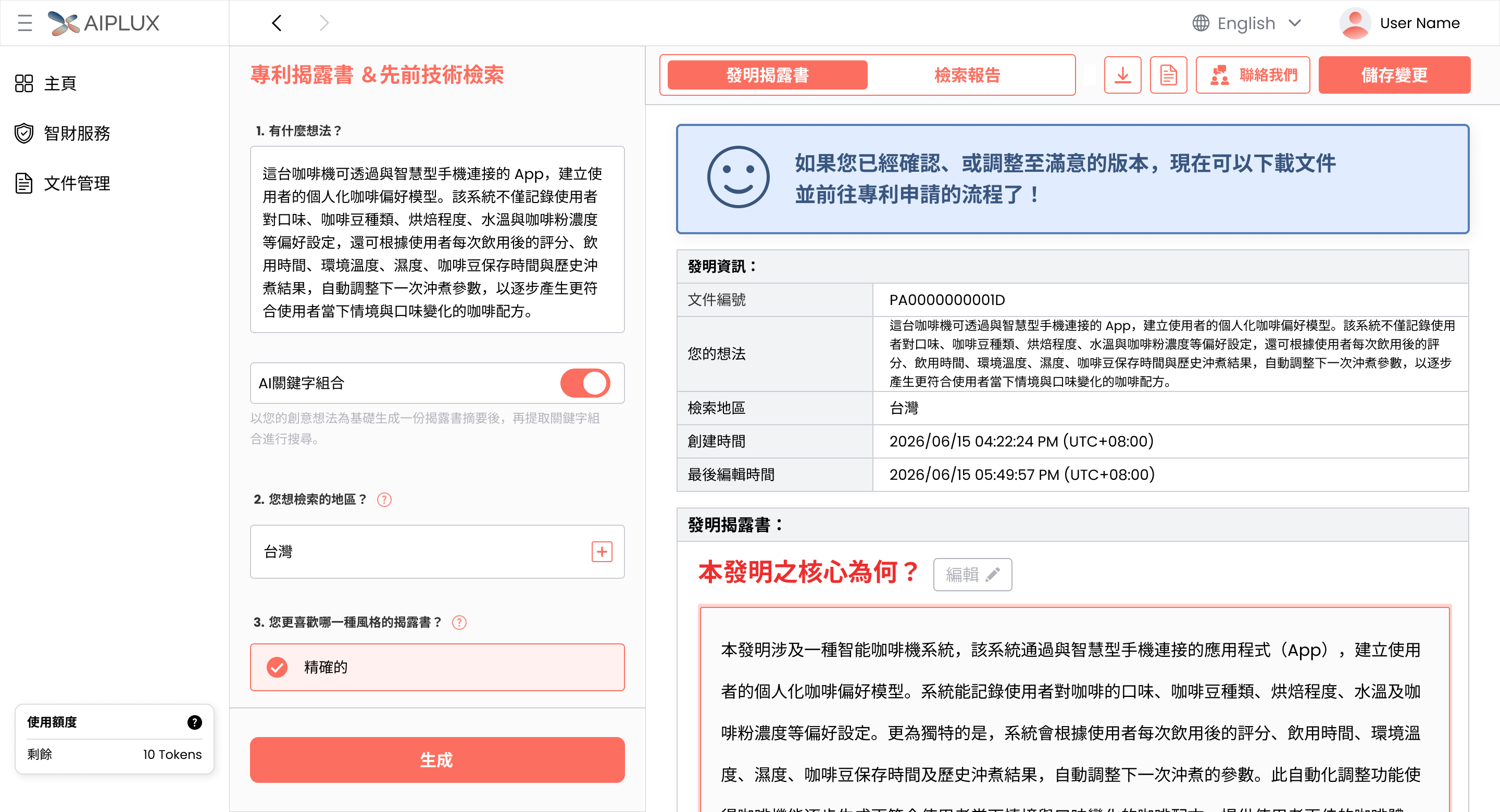
INPAS brings technical ideas into the patent process faster

Reduce repeated communication
Guided Q&A helps gather technical key points at once, reducing back-and-forth confirmation.
'%3e%3cpath%20id='Vector'%20d='M9.21742%2041.3913H5.73914C4.77859%2041.3913%204%2040.6126%204%2039.6522V8.34778C4%207.38724%204.77859%206.60864%205.73914%206.60864H9.21742V41.3913Z'%20fill='%23496792'/%3e%3cpath%20id='Vector_2'%20d='M39.2171%2035.3044V42.2609C39.2171%2043.2214%2038.4385%2044%2037.478%2044H9.65198C8.69144%2044%207.91284%2043.2214%207.91284%2042.2609V5.73914C7.91284%204.77859%208.69144%204%209.65198%204H37.4781C38.4386%204%2039.2172%204.77859%2039.2172%205.73914V25.7391'%20fill='%23557DB8'/%3e%3cg%20id='Group'%3e%3cpath%20id='Vector_3'%20d='M18.1303%2037.0435C18.1303%2037.4037%2017.8383%2037.6957%2017.4781%2037.6957H13.9998C13.6397%2037.6957%2013.3477%2037.4037%2013.3477%2037.0435C13.3477%2036.6834%2013.6397%2036.3914%2013.9998%2036.3914H17.4781C17.8384%2036.3914%2018.1303%2036.6833%2018.1303%2037.0435Z'%20fill='white'/%3e%3cpath%20id='Vector_4'%20d='M23.5651%2032.9131H13.9998C13.6397%2032.9131%2013.3477%2033.2051%2013.3477%2033.5653C13.3477%2033.9254%2013.6397%2034.2175%2013.9998%2034.2175H23.5651C23.9252%2034.2175%2024.2173%2033.9254%2024.2173%2033.5653C24.2172%2033.2051%2023.9252%2032.9131%2023.5651%2032.9131Z'%20fill='white'/%3e%3cpath%20id='Vector_5'%20d='M13.9998%2012.4783H33.1303C33.4905%2012.4783%2033.7825%2012.1863%2033.7825%2011.8261C33.7825%2011.466%2033.4905%2011.174%2033.1303%2011.174H13.9998C13.6397%2011.174%2013.3477%2011.466%2013.3477%2011.8261C13.3477%2012.1863%2013.6397%2012.4783%2013.9998%2012.4783Z'%20fill='white'/%3e%3cpath%20id='Vector_6'%20d='M33.1304%2019.8696H32.2608C31.9007%2019.8696%2031.6086%2020.1617%2031.6086%2020.5218C31.6086%2020.882%2031.9007%2021.174%2032.2608%2021.174H33.1304C33.4905%2021.174%2033.7825%2020.882%2033.7825%2020.5218C33.7825%2020.1617%2033.4906%2019.8696%2033.1304%2019.8696Z'%20fill='white'/%3e%3cpath%20id='Vector_7'%20d='M28.3478%2014.6522H18.7826C18.4224%2014.6522%2018.1304%2014.9443%2018.1304%2015.3044C18.1304%2015.6646%2018.4224%2015.9566%2018.7826%2015.9566H28.3478C28.7079%2015.9566%2029%2015.6646%2029%2015.3044C29%2014.9442%2028.7079%2014.6522%2028.3478%2014.6522Z'%20fill='white'/%3e%3cpath%20id='Vector_8'%20d='M33.1304%2023.3479H32.2608C31.9007%2023.3479%2031.6086%2023.6399%2031.6086%2024.0001C31.6086%2024.3602%2031.9007%2024.6523%2032.2608%2024.6523H33.1304C33.4905%2024.6523%2033.7825%2024.3602%2033.7825%2024.0001C33.7825%2023.6399%2033.4906%2023.3479%2033.1304%2023.3479Z'%20fill='white'/%3e%3cpath%20id='Vector_9'%20d='M27.9129%2023.3479H13.9998C13.6397%2023.3479%2013.3477%2023.6399%2013.3477%2024.0001C13.3477%2024.3602%2013.6397%2024.6523%2013.9998%2024.6523H27.9129C28.273%2024.6523%2028.5651%2024.3602%2028.5651%2024.0001C28.5651%2023.6399%2028.273%2023.3479%2027.9129%2023.3479Z'%20fill='white'/%3e%3cpath%20id='Vector_10'%20d='M27.9129%2019.8696H13.9998C13.6397%2019.8696%2013.3477%2020.1617%2013.3477%2020.5218C13.3477%2020.882%2013.6397%2021.174%2013.9998%2021.174H27.9129C28.273%2021.174%2028.5651%2020.882%2028.5651%2020.5218C28.5651%2020.1617%2028.273%2019.8696%2027.9129%2019.8696Z'%20fill='white'/%3e%3c/g%3e%3cpath%20id='Vector_11'%20d='M43.6521%2025.9131L34.5216%2038.087C34.1932%2038.5249%2033.6777%2038.7826%2033.1303%2038.7826C32.5829%2038.7826%2032.0674%2038.5249%2031.739%2038.087L27.8259%2032.8696C27.2497%2032.1012%2027.4054%2031.0111%2028.1737%2030.4348C28.942%2029.8585%2030.0323%2030.0142%2030.6085%2030.7826L33.1302%2034.145L40.8694%2023.8261C41.4455%2023.0577%2042.5356%2022.902%2043.3041%2023.4783C44.0726%2024.0547%2044.2284%2025.1448%2043.6521%2025.9131Z'%20fill='%23FF8679'/%3e%3c/g%3e%3c/g%3e%3cdefs%3e%3cclipPath%20id='clip0_0_1'%3e%3crect%20width='40'%20height='40'%20fill='white'%20transform='translate(4%204)'/%3e%3c/clipPath%3e%3c/defs%3e%3c/svg%3e)
Improve document completeness
Presents technical content in a structured way, convenient for subsequent review and extension.

Accelerate early patent work
Shorten the preparation time from idea to disclosure document, keeping patent timeliness in hand.

Preserve room for professional judgment
AI assists with organizing and generating, without replacing the judgment of patent professionals.
AI doesn't replace expertise,
it makes expertise more efficient
The core design of INPAS is to help patent professionals obtain complete, auditable, and extensible technical materials faster. AI reduces the burden of repetitive organization, while professionals continue to handle judgments on patent strategy, application scope, and rights layout.

Auditable
Generated content retains room for manual review and modification.

Traceable
The process design emphasizes the context between input content and generated results.

Deployable
Aligned with the actual workflows of enterprise R&D, legal, and IP teams.
Ready to turn your technical idea into a patent document?
 When AI Meets IP


